Part 1

The 2024 Training Run:
When I first decided to sign up for the Cocodona 250, I saw that they offered a training run that covered the first infamous 37-miles of the course from Black Canyon Ranch to Crown King. The section has been known to decimate runners before they even make it to the first crewed aid-station at Crown King. And for good reason. There is 10,000 ft of gain, in the remote Bradshaw Mountains, on piles of loose rock. It’s steep, completely exposed, with a 24 mile stretch that has no aid-station. It’s steep, rugged and hot as hell.
If I was going to try and tackle a race of this magnitude, a 250-mile point-to-point foot race that takes runners through trails and mountains and river-crossings that begin in Black Canyon City and wind their way to downtown Flagstaff, Arizona, I thought it would be wise to wrap my mind and body around this first section, which most veterans argued was by far the toughest section of the entire course.
I’m from upstate, New York and had never been to Arizona. I’m not a fan of the heat; in fact, I loathe running in hot weather which made my choice of a 200-plus mile foot race in AZ a bit counterintuitive. But I had been drawn in by the allure of the Cocodona 250 since it began its livestream during the inaugural year back in 2021. I thought it was hysterical that they had a “livestream” of a 250-mile race. It was strung together with some drone-shots of runners out in the desert and some stationary cameras placed at strategic aid-stations along with a few cellphone clips and live interviews with runners by volunteers with video cameras out on the trails. Mostly it was just people chatting and some really poor footage at the race finish. Yet, I was pulled into it. Like watching the OJ Simpson car chase, all of a sudden, I couldn’t turn my eyes away from this 5-day long foot race being lived streamed or at the very least, following the runners’ dots along the course from their spot-trackers adhered to their packs. I found myself up late at night following the crude livestream and seeing a ragged, but victorious, Michael Versteeg, coming into Heritage Square in downtown Flagstaff for the win. He had long, stringy hair and a beard and looked like a ultra-Jesus coming into the city after his epic sojourn in the desert.
After having successfully finished the Moab 240 in October of 2023, I was hungry and excited for a new challenge. Not only did I sign up for the training run, but I also decided to jump into the Coldwater Rumble, a 100-mile race in Goodyear AZ that is also put on by Aravaipa Running in mid-January. The 100-miler would be a great training run and also familiarize myself with some of these desert-styled ultras. It was a well-organized, low-profile race where I got to meet and cheer on two of my ultra heroes, Devon Yanko and Jeff Browning (aka Bronco Billy) —who were battling for the win. Browning was able to pull it out but not without some heat from Yanko. It was so fun to see them sprinting past me (they were finishing their 3d loop while I was still on my 2nd,) and being able to shout “Giddy Up!” to Bronco as he few past me on his way to the finish line.
Despite it being a well-marked course, there were so many different races going on that I ended up following the 10K runners and got myself off-track for about 5 miles with a man named Seamus, (the same name as my eldest son,) from Arkansas. That was a bummer, but eventually we made our way back to the loop that we should have been on and around and around I went, finishing the race in approximately 27 hours. It wasn’t a sexy course. It was just rocks and cacti and sand washes, but it gave me some confidence and a taste of Arizona running. Getting lost was also some good mental training because as much as it sucks, it’s kind of par for the course in an ultra, especially one that is 250-miles long. Even if they could put a confidence marker every 20ft, by day 3 you’re so delusional that you might think a plastic bag caught on a branch is a directional sign.


The training run was the best decision I could have made. I flew out to Phoenix, without knowing that the city was hosting the Men’s Final Four NCAA basketball tournament and hotels were nearly impossible to come by. When I did find one, it was on northern edge of the city, and felt more like a half-way house than an actual hotel. When I walked in the police were in the lobby escorting a man out who had over-stayed his welcome and was refusing to leave his room. As luck would have it, my room was right next where he had squatted for the past two weeks and there were mounds of garbage left outside his door. The smell was rancid.
Needless to say, I couldn’t wait to get out of my hotel room and onto some trails. I drove to Black Canyon City and did a little test-run on the course that I had downloaded onto my Strava app. It was a bit confusing. I had to take my shoes off and wade across a stream and then got turned around on the trails a bit but I ended up logging in at least 6-7 miles on the first section of the course and saw some beautiful desert flowers in bloom. There was this confusing part where I had to hop off a road and onto a trail that didn’t really look like a trail, because it was in fact an old drainage ditch that was overgrown and moved through shale. I cut myself coming down but was grateful that come race day, or even training camp day, I would know where to turn and what to expect.
My coach, Andy Jones Wilkins (AJW) lives in Phoenix and was going to do the training run as well. The following day, our plan was to both drive up to Crown King, where I would leave my rental car and he would take me back to my hotel. That way, when we got done with the training run, we could just drive back to Phoenix together. It was good planning on AJW’s part, but I almost had heart-attack on the drive up to Crown King. It was a narrow road with no shoulders, that snaked up the mountain with increasingly steep drop-offs on one side and ATV’s trying to pass me on the other side. AJW had to keep waiting for me as I was doing a slow crawl in my rental vehicle trying not to do any damage and stave off an anxiety attack.
Crown King was a wild desert mountain town with its own General Store and school and all kinds of interesting folks and cabins and of course the oldest operating saloon in the country with a wooden sign that read, “Cheap Whiskey. Loose Women.”
I had seen pictures and videos from Crown King but it was different to be there in person. It was like being dropped into a place that existed outside of time where cowboys and hippies and home-schoolers and rugged mountain folk all comingled together high up on a hill in the middle of the Bradshaw’s. It was fascinating and at least I now knew where I was trying to get to the next day.
AJW picked me up at the crack of dawn. We made our way to Black Canyon Ranch where there was approximately 30 people there for the training run. This was lining up to be the most competitive 200+mile race ever assembled and even at the training run there were some ultra-elites like Bronco Billy and Arlen Glick–an ultrarunning Mennonite from Ohio, whose hair was always perfectly in place and whose smile looked like a teeth whitening add. He had been living in Arizona for the past two months in preparation for the race. I introduced myself to him and he was as sweet and kind in person as he was in interviews. There were also runners of every age and shape and background and most of them, looked as scared as I did. They had that “what in the world have I gotten myself into look?” which is precisely why we were all there at 6am on a Saturday morning in April.
Steve Aderholt, the Cocodona 250 Race Director, explained the need for us to all be carrying enough water and that we had to make sure we had the course downloaded on our phones and/or watches because “no one is coming to help you if you get lost.” This was an unofficial training run to help people get a sense of this first, brutal section, but it was not without risk.
He said that he and some volunteers would make their way out to the course at two different spots—similar to where they’d be in the race. One water stop would be approximately 7 miles in and the 2nd water refill would be approximately 32 miles in. The rest? That was on us. AJW had teamed up with Pam Reed, the legendary ultrarunner and triathlete who had blazed the way for so many women in this sport. She was just out to have an adventure with some friends but was not planning on doing Cocodona.
Here’s what I discovered on this 37-mile section. It’s almost all uphill. It’s a huge pile of rocks, many of them loose. The higher you climb, the more beautiful the views get. And you are, at almost all times, save the very beginning at Black Canyon Ranch and the very end, on the road into Crown King—in a remote and desolate and exposed mountain range that you don’t want to become lost in, nor do you want to run out of water in because the streams are not always flowing and there are no roads or easy access points for people to get to you. The only way out is either up or down and for this run, we were going up. Straight up. When I say “up” I mean there were some hand-over-feet type of rock scrambles and no sure footing. Any rock you stepped on could and often did kick out from beneath you. It was an exercise in deep mindfulness as you had to place each foot carefully and if secured, hoist yourself up to the next ledge or rock.
There were places in between the brutally hard climbs that were somewhat runnable and during those stretches I would run with people for a few miles and learn a little bit about them and why there were there. Most were training for Cocodona, but there were others who were training for the Sedona 125-mile race that would take place in the midst of Cocodona, but just on a shorter version of the course. There was one woman with a knee brace on that looked to be in her late 50’s would fly past me on the steep ascents. I was amazed. There was another man, with a stocky build, who seemed to be going very close to my speed. He’d either be slightly in front of me or slightly behind me, but we were never too far from each other. That provided me with some comfort as the miles clicked on because there were some very uncertain turns and navigation that we had to do without any confidence markers. At one point, I went down the wrong hill when I should have made a turn onto the Lane Mountain Trail. It was very difficult to see and he called out to me and signaled to the turn I should have made. We didn’t really talk much. It was a hard section to do much talking on, especially that latter part, but we kind of moved in sync together.
As Steve said, “it’s probably 30 degrees cooler today than it will be on race day.” I didn’t like to think about that, and kept applying sunscreen and making sure I was drinking and fueling as we climbed. It was hot enough for me and I cringed at the thought of making my way through this section if it was 90 degrees. There was no shade. There was nowhere to run or to hide. There were just more rocky paths to climb and a few to descend. I really enjoyed the part where we got further up and the mountains became forested and there was finally some shade and moisture and some reprieve from the sun. When we hit our last water station, Steve and two, very upbeat and kind volunteers, said it was a straight shot down a road all the way into Crown King.
When I came into the mountain town, I was exhausted, cut up from rocks and cacti but I felt accomplished. Now I knew what that legendary section was all about. And it deserved its reputation. It was rugged and burly and unrelenting, but I had gotten through it in approximately 11 hours. The cut-off was 18 hours. So, that was less of a worry now but I didn’t know what it would be like in the heat, but I knew how arduous the climb really was. I went into the saloon and sat at a table with a couple of the other runners. Jake Jackson was there, a fairly well-known ultrarunner who was talking with Zach Bates, a young man with autism who was taking on the Cocodona 250 challenge. Zach had also joined us on the training run and I was able to meet he and his mom at Crown King. I was moved by both his passion for the sport and her devotion towards helping him achieve such a monumental goal.


When AJW and Pam Reed came in with another friend they ordered some food and drinks and I sat with them for a bit. I was honestly in awe of Pam. She had just completed the Pam trifecta of Western States 100, Badwater 135 followed by Hardrock 100. All within a three-week period. She was also 61 years old and just cruised up to the top of the Bradshaw Mountains and into Crown King like it was her morning walk with a neighbor.
AJW, Pam and her friend and I all piled into my rental car and drove back to the start-line together. When I got back to my hotel, I was fairly gutted but giddy. Having done that first section made me believe that completing the Cocodona 250 was at least possible. I could visualize the start and sometimes, that’s all you need. See yourself through 37 miles and the rest? Well, I’d figure out as I went.
Before heading home, I did do a hike/run at Mingus Mountain and spent another day running around some trails in Sedona, just to familiarize myself with two more sections. Aravaipa is great about publishing the sections that are open to the public all year round but caution runners, with good reason, from trying to do any sections that are on private land as they take permission and permitting for race day (well, race-days in this case.) I got turned around a few times on the approach to Mingus but eventually found the trail up. And it did go straight up! There were some beautiful vistas and then towards the top the single-trail switched into more of a jeep road and I thought I should be feeling less winded, but I kept stopping to walk. It was taking a toll on my confidence. Yes, I had done the 37-mile section the day before, but this was only a 7-mile stretch and come race-time I’d be doing 250-miles within a few days. Why was this so hard for me. Eventually I made my way passed the Mingus Mtn Camp where I knew would serve as an aid station during the race. Then there were a lot of cell-towers and forest service roads and eventually I came to a view of the Verde Valley. There was also a launching pad for skydivers that read 7,900ft. Duh! That’s why I felt so crappy! My sea-level physique was suddenly thrust into altitude and I was feeling every bit of it. But it was a relief to know what the culprit was. Altitude was going to be hard for me in some of these segments but now I knew what was making me feel so crappy. It wasn’t that I was not in shape for this adventure, it was that I was not in altitude-shape. Nor would I be. I’d just have to get up and down the mountain as quick as possible.


I’d heard that the descent from Mingus to Jerome was tough. Really tough. That’s coming from the veteran ultrarunners and the front-of-the-pack peeps. I wanted to get a sense of it and started down a snowy, muddy, single-track trail that led off of Mingus Mountain but then thought better of it. It’s a 17-mile section and I’d already been out there for a few hours. Best to hedge my bets and get back down to the trailhead and get back to Phoenix before dark, when my hotel morphs into a meth lab.
There were some beautiful Ponderosa Pine and various Christian camps and cabins configured near the top of Mingus. I tried to familiarize myself with the trails and then moved down and around this gulley to log in some extra miles in the woods without getting too far away from the trailhead.
Sedona was beautiful. Take-your-breath-away beautiful but also very wealthy and quite a driving distance from Phoenix. It was very bourgeois and everything looked like it cost a lot from the homes to the outfits to the crystal shops. But once I was on the trails? It was a runner’s paradise. I kept stopping to take pictures because it was hard to soak it all in. The desert colors the buttes and mesas and canyons and springs. I was able to find the trail that led from this thin, gorgeous suspension bridge down to Oak Creek where the waist-deep water crossing would be. It was a tricky turn off the trail towards the Creek so I was happy that I found it as this was going to be a critical juncture. I had listened to one podcast where a runner, the previous year, crossed here in the night with all of his night gear on and didn’t realize how fast the current was moving was knocked over into the water, which left him and all of his gear sopping wet. He went hypothermic and thankfully some nice runners found him just past the river shivering in the bushes and lent him some warm, dry clothes and got him to the next aid-station where he could warm up.
So, seeing this spot, where there would be a rope to help navigate across the river was important to me. I would hold on to the rope as tight as possible and make sure my warm-weather gear was in a water-proof bag just in case!
Seeing where it was that I had to turn to get to the river-crossing before climbing up Casner Canyon. While the trails were stunning, they were hardly flat and I thought to myself, “okay, 150-miles into this? These are not going to be easy!”
I left my DIY training trip with the confidence that I’d seen one, large section of the course, and two portions of other sections in the course. This still left more than 200-miles to discover during the actual event. But just having completed that first section, experienced how much the altitude impacted me on Mingus and being able to look forward to the beauty of the Sedona trails, was more than I’d ever had before in a race.
Cocodona 250: Race Start 6am


Start to Cottonwood Creek Aid-Station 7.4 miles (1,423ft of gain and 1,339 ft of loss)
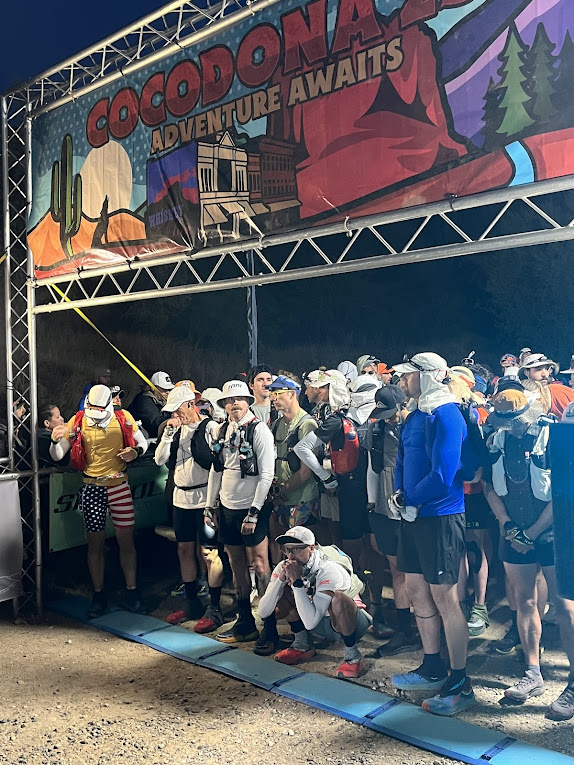
It was dark. It was early. It was windy. The dust was kicking up everywhere and there was a longline for the spot-trackers. I was in that deep quietude, knowing that something monumental lay ahead of me. After all of the angst of the day before where I felt unsure of myself and like an imposter in an arena of very fit, very accomplished runners, as this was the most competitive field of runners ever assembled for a 200+mile race, I nursed a cup of instant coffee on a chair off to the side of all the early morning action and started to pray.
I asked God and everyone who loved me to stay close to me. My oldest son, Seamus was there to help crew me, along with my partner, Kip. I felt so grateful that they were both there and willing to help me on this crazy journey. I let that gratitude sink in. Kip gave me his flannel shirt as the wind was whipping. My spot tracker was on but the line just kept getting longer. I moved behind the corral. Slipped that silly, white, hat with all of the flaps that looked like the Snoopy cartoon character’s aviator hat. I wasn’t alone. I would say that 70 percent of the runners all had the same Outdoor Research hat one making us look a bit cultish. With the poles and the packs and the white hats all gathering behind this tent, we did look some roadside Baptist Church folks getting ready to start talking in tongues. We all would be, talking in tongues that is, at some point during this epic foot-race that would go from Black Canyon Ranch to Flagstaff.
Seamus was talking with me and keeping me company behind the start line. There were the elite runners and the influencers with their Insta 360’s ready to document their experience for their followers. The 200+mile sport is still small enough that I recognized a good number of people from social media or from the training run, or from the expo and check-in the day before. I hugged Kip and Seamus who made their way to the front of the start line so that they could get some pictures and video clips. I turned inward and told myself that I had done everything within my power to prepare for this race. That I knew to be true. There was a deep relief in that. Whatever happened was going to happen but at least I could take comfort in the fact that I had logged in some 100+mile weeks and done the training run and completed a 100-miler only a few months before and now it was just time to start putting one foot in front of the other.
Steve Aderholt, the RD, was on the bull horn and said that the start would be another 10-15 minutes as racers were still getting their spot trackers on. I checked and double checked my 4-liters of water. I went with two-hard bottles, two soft-flasks and a 2-liter bladder which equaled a little over 4-liters, the required amount for this section. UltraAspire had really helped me figure out how to carry that much water without it being too cumbersome or unmanageable. I was using the Zygos 5.0 pack with their waist belt. It had been fun to meet their team the day before including Zack, their customer service rep and their owner, Bryce Thatcher. They’re a small, independent business out of Utah that cares deeply about how they can create vests, headlamps and various gear that runners or endurance athletes need to handle specific distances and terrain. They’re the kind of business that answers the phone when you call and helps to trouble shoot a problem you may be having with the battery in your waist lamp minutes before the gun goes off at the start of the race. They had a lot of their sponsored athletes competing in the Cocodona 250 and were working hard to figure out how to get everyone fitted with enough carrying capacity for that 1st section. They’re just good people with good products and it’s funny how important those things become when you’re basically relying on that pack and that headlamp to carry you through 250-miles. It’s not just a purchase; it’s a survival tool.

Common wisdom was to carry very little water and fill up at the first aid-station and Cottonwood Creek, but I was in the mindset of having what I needed with me or on me so that I didn’t have to stop. Not that I was going to be moving at a blazing fast speed, but once I became locked and loaded, I wanted to stay that way for as long as I could.
The music stopped playing, a hush fell over the crowd of runners. Aderholt gave a beautiful speech about enjoying the process and the memories we were about to make and then the countdown began. Only 30 seconds after I had started running one of my soft-flasks spilled out of my vest pocket and I had to stop and try and grab it while everyone was running past me or over me. I felt like such a spaz. I found it, tucked it back in and waved to Kip and Seamus. Then we made a hard-right and were on the Black Canyon Trail (BCT) I had a headlamp on but the sun was beginning to rise. We twisted in and out of the Saguaro Cactus and Ocotillos and it was beautiful and somewhat cool. I kept telling myself to watch my feet as I didn’t need to take a header this early on in the race. Although we would soon become very spread out, at this point, it was a conga line of runners with large hats, packs and poles moving along a narrow, winding trail.
It was all adrenaline in those first few miles. I tried to quiet my heart rate and focus on my feet and finding a rhythm that was smooth and sustainable. No need to go out hot in a 250-miler especially when that first section is almost all uphill for 37 miles.
It was nice to know this section of the course and when we would get off the trail and hit a rolling double-track and exactly when that double-track made a sharp left onto a trail that was really a drainage ditch that we had to climb up for over a mile. It was brambly and thorny and had a lot of loose rock and required focus not to slip and fall. I listened to the conversations around me. I’m always amazed how people can chat during races. All of the energy I have is put into reserves, knowing I’m going to need every ounce of it over the long haul. But it was nice to be distracted by the chatter. Who has done the race before, what happened to them last year that they did not finish (DNF) how many 100-mile races they’d done, what type of injury they were coming back from, how they had slept the night before the race….it all took my mind off the task at hand and the task at hand was something so big that I couldn’t look at it all at once.


We went from the drainage ditch to the BCT again and it was gorgeous as the sun was rising. After winding another couple of miles, we were directed to a double-track backroad and after another ¾ of a mile we were making our way towards our first aid-station.
The sun was fully up by the time we got to the Cottonwood Creek. I had been sipping from one of my .5-liter soft flasks and went up to the volunteer who had a pitcher of water and asked them to fill it. The line at the aid-station was long and I was happy that I had carried my water with me. I reminded myself to eat a bar as I was trying to get in 200-calories an hour. I didn’t have any hard and fast method for that, I would just rely on myself to remember. I had packed just enough calories to try and hit that goal on the way to Crown King which was coming up next. I thanked the volunteers, used my Sally McRae “Yellow Runner” buff that Zack had given me from UltraAspire, to wipe off the sweat that was already starting to drip down my face and kept heading up the old, washed-out road that was moving steadily uphill. I knew what was coming. It was a lot of climbing. A lot of rocks. And a lot of exposure. After I wiped off the sweat, I took out a little tube of SPF 70 that I had and applied sunblock to my arms and face and neck. After that I looped my thumbs around my pack straps and psychically pulled into myself like a turtle seeking protection. It was going to be hard. I accepted that. It was just time to put my head down and go.
Cottonwood Creek Aid-Station to Lane Mountain Aid Station 32 miles (25.1 miles with +9,518ft of gain and -4,856ft of loss)
This is just climbing up big piles of rocks. So many rocks. As if all the rocks in the entire world from small pebbles to boulders had all been thrown into this one section by either an angry or playful God. There’s no way around it. I had already done it once, thankfully, so I knew that it was going to suck. But it’s the beginning of the race and I kept telling myself that I was getting the hardest part over with first. That mantra helped. My legs were also the freshest they would probably be the entire race so if I was going to climb up mountains of rocks with the sun beating down on me and no shade or hope of shade anywhere? This was the time. Whenever there were some old roads or washes or even downhill sections, I would try and run. More of a shuffle. Always watching each step to make sure I didn’t trip on a rock or slam my toes into one. This did happen, several times, but overall, I think I managed well. There are a few streams and some of them had a bit of water. I remember coming around this one bend where there was a cottonwood tree and seeing Wes Plate, a popular 200+runner who makes these great documentaries on all of his races for the rest of us to enjoy and get some reconnaissance in. He had done Cocodona every year since it’s inception but he was looking rough at the moment. He said he just needed to take a break and cool down and hydrate. It kind of scared me. If Wes was having a rough time in this section, which one of us was next?
I kept sipping on my electrolyte mix (LMNT mixed in with water) and eating every hour or so. Fig bars and gels and chews and waffles. I had no desire to eat, but I made myself. I knew that this section was a make or break one and I had to stay on top of hydration and sunscreen and footing and fuel.
While it’s mostly one big climb, there are some rolling sections that offer a couple of steep downhills but unfortunately, they were so steep and littered with sharp rocks that it was more jigsaw-foot puzzle trying not to wipe out than it was a relief from the climbing. There were some cows out on the trails and an old windmill and some abandoned mining structures, but mostly it was as barren as the moon but a hell of a lot hotter. The higher you get the more beautiful the vistas are as you look back on the rolling shoulders of the Bradshaw Mountains. I drank all of the water from my 2-liter bladder and only had one hard-bottle of water left. I knew we were coming to a water-only station at the bottom of a hill just past a creek that was barely trickling.
When I finally made it there, at mile 24, and went to hand the volunteer my two soft-flasks, he explained that we were only allowed to have .5 liter of water. Someone had taken or drank all of their water from the jugs that they had left out the night before and they were having to ration the water they were porting in on foot. Instead of the 1 liter, we could only have .5 liter. Doesn’t sound like much but when you’ve been running/hiking for 8 hours uphill in the heat of the day? Every drop counts.
I thanked him and said I was sorry to hear about the water-bandit and began to make my way up towards the Lane Mountain Trail. It was getting increasingly hotter as the miles went on and the elevation climbed. I tried to sip on my soft flask and kept telling myself that I had that one water bottle left in reserve. Shit happens in ultras, especially an ultra this long, so I told myself to relax. It got incredibly steep here, or maybe it was steep the entire time, but there were some sections where I felt like I had to fully propel myself up to the next rock or else go tumbling backwards.

As I passed runners or they passed me, they were constantly commenting on how I was “old school,” or “bad ass,” for not using poles. I think I was the only person not using poles, or at least the only person I saw along this section that was not using poles. I questioned my choice of leaving them behind. They could have definitely helped me on some of this terrain but I also feared that they would be cumbersome and just one more thing to trip over. I was huffing and puffing and in my own mental zone so I couldn’t really respond to these comments, but I wanted to explain that it wasn’t badassery but just a fear of gear. I’m a less-is-more type of runner. The two things I was most concerned about on this section was having enough water and keeping myself protected from the sun. To that end, I had the white baseball hat with the attached neck flaps and a Rabbit long-sleeved EZ Tee that had SPF protection and was so light and breathable that it felt cooler than a tank top and kept the sun off my skin. These purchases (along with a sun hoodie from KETL) were all suggestions from the Cocodona 250 Facebook running group. They were so helpful when it came to questions about gear and who better to trust than the people who actually had run the race in previous years? I didn’t have sun leggings because I had a limit, but I did see people, including Mike McKnight, one of Cocodona’s previous winners, rocking the white tights. I had some black shorts on that a friend had given me and they were just comfortable. Gaiters were also critical because of all the pebbles and sand and prickers that were out there. Shoes? Well, embarrassingly, I just wear my ASCICS Gel Nimbus Road shows because I’m used to them and despite having no traction, whatsoever, they did help me through my 3 100-mile runs and the Moab 240. I’m sure there were better choices, in fact I know there were better choices, but I was sticking with what I knew.
I was grateful to get to that tricky area, around mile 26, where the old jeep road wants you to keep going straight (and downhill) but you actually need to take an obscured right-hand turn to the Lane Mountain Trail. Unlike the training run, the turn was now marked and since I had messed it up before, I was on the lookout for it. The Lane Mountain Trail is beautiful. There were desert flowers in bloom and the higher up the single-track trail I went the more diverse the landscape became. There were Ponderosa Pines that offered some shade from the heat and the trail twisted just enough to keep me wondering what was around the corner. I knew were weren’t too far from that last aid-station before the smooth gravel road into Crown King. That kept me motivated and excited. All it took was a little bit of shade and the knowledge that some of the hardest climbing was almost behind me. While I was feeling a surge of energy, I kept passing runners that had found a patch of shade and were lying down or sitting down recouping. I couldn’t blame them. It had been a hell of a lot of climbing in the sun and those patches of shade were like tiny oasis.
The temps were cooling down a bit and I felt myself coming to life. Just thinking about getting some Coke at the aid-station and then only a few more miles to Crown King where I’d see Seamus and Kip? It kept me pressing forward and not stopping to sit in the shade with my fellow competitors which looked all too enticing.
As I popped off the single-track trail things opened up and I remembered having to take a right-hand turn onto a smoother double-track trail. It felt good to let my legs open up and run. After a bit I could hear the aid-station activity and I was so excited. It was being run by UltraAspire and saw Bryce Thatcher who gave me a big hug and Zack and a plethora of runners and volunteers. All I asked for was Coke and a kind woman filled up my soft flask and I thanked her and off I went towards Crown King, stopping just long enough to gulp down some soda. Nothing like some cold Coke to refresh the body and soul.
Lane Mountain to Crown King 36.6 miles
4.1 miles (+338ft of gain and -1,304ft of loss)
As I left Lane Mountain, I felt refreshed but also still wary of the sun. The dirt road was smoother than what we’d been on but any slight incline felt much greater than it was after so much climbing. I told myself to just start to run easy and soon the road would start to trend downhill. I knew I could fill up on water and electrolytes and food at Crown King. Seamus and Kip would be there and just to be extra cautious, because things can happen to crew (flat tires, getting lost, wrong timing) I had packed a drop-bag with all of my night gear (headlamp, waist lamp, pants, jacket and backup batteries.) So, I sipped on my Coke and just started to let my legs stretch out. As I made my way down the road, I kept thanking God for helping me get through that section unscathed and reveling in every bit of shade that was now throwing its arms towards me.

Every so often a truck or some ATVs would drive by, some would honk in support of the runners. I could always see a runner in front of me or behind me but we were already starting to spread out. As I hit the part of the road that I knew would lead downhill towards Crown King I started to pick up my pace. I can’t say that was wise, but it felt fun. I felt strong and so ready to see my crew.
As I got closer there were more people cheering and ringing cowbells and Crown King residents clapping and it all made me move faster and faster and I made that left turn into the little mountain town with a huge smile on my face and just a sense of elation that I had made it this far. I was inside the race now. Kip and Seamus were there, cellphones out, snapping pictures and videos and then I just hugged them both and checked in with the volunteer who took my bib number and found a place to sit down. I had arrived at approximately 4:45pm about 10.5 hours since the start. It was busy at Crown King aid-station and there was a wait for food. I thought a black bean burger with cheese would be good so they ordered that for me. Spring Energy was there (before the scandal) and they were offering smoothies which I graciously took. In fact, I couldn’t get enough of the Spring Energy smoothies and kept going back for more refills. The cool, fruity, icy mixture was so revitalizing. Kip and Seamus went to work refilling my bladder and soft flasks with my electrolyte mixture. They had some wipes so I could get all of the dirt and dust off of my face. I think I had gotten there in approximately 11 hours. Similar to the training run, so that made me feel good because it was at least 30 degrees hotter. It was exhilarating to go from the barren landscape of the rocky climb to the hive of activity at Crown King. I asked Seamus and Kip what they thought of the saloon and the crazy drive up and we chatted while I ate my burger. I asked them to find a way to get some ice-water on me which they were able to do, just to bring my core temperature down. It’s all a little hazy at this juncture because there were so many people (relative to where I had just been) and music playing and cars going in and out and livestreams and cameras and food offerings and I needed to focus and make sure I had everything that I needed so that I could head out of there without rushing too fast but without dawdling. It’s a fine line in a 250-mile race. Mostly, I was just happy here. Yes, it had been a hard climb. But I knew that. And I had made it. There was a sense that one of the biggest hurdles to this endeavor was already completed. 1/3 of the total climbing was out of the way. Now I just had to make it through the night and get to my crew again at Whiskey Row, in downtown Prescott around mile 70. Our plan was for me to keep moving until the next crewed aid-station (Whiskey Row) where I would take a 1.5-to-2-hour nap. If I needed to sleep before then, I would just shut my eyes at one of the aid-stations or along the trail. It was hard to leave them because I knew it would be a while before I saw them again. They snapped a picture of me outside of the saloon and off I went, Seamus running next to me until I had to make a left turn and wind my way out of this wild mountain town.
Leave a Reply to Cocodona 250 Race Report Part 2 – Erin QuinnCancel reply