10 Things No One Told Me About
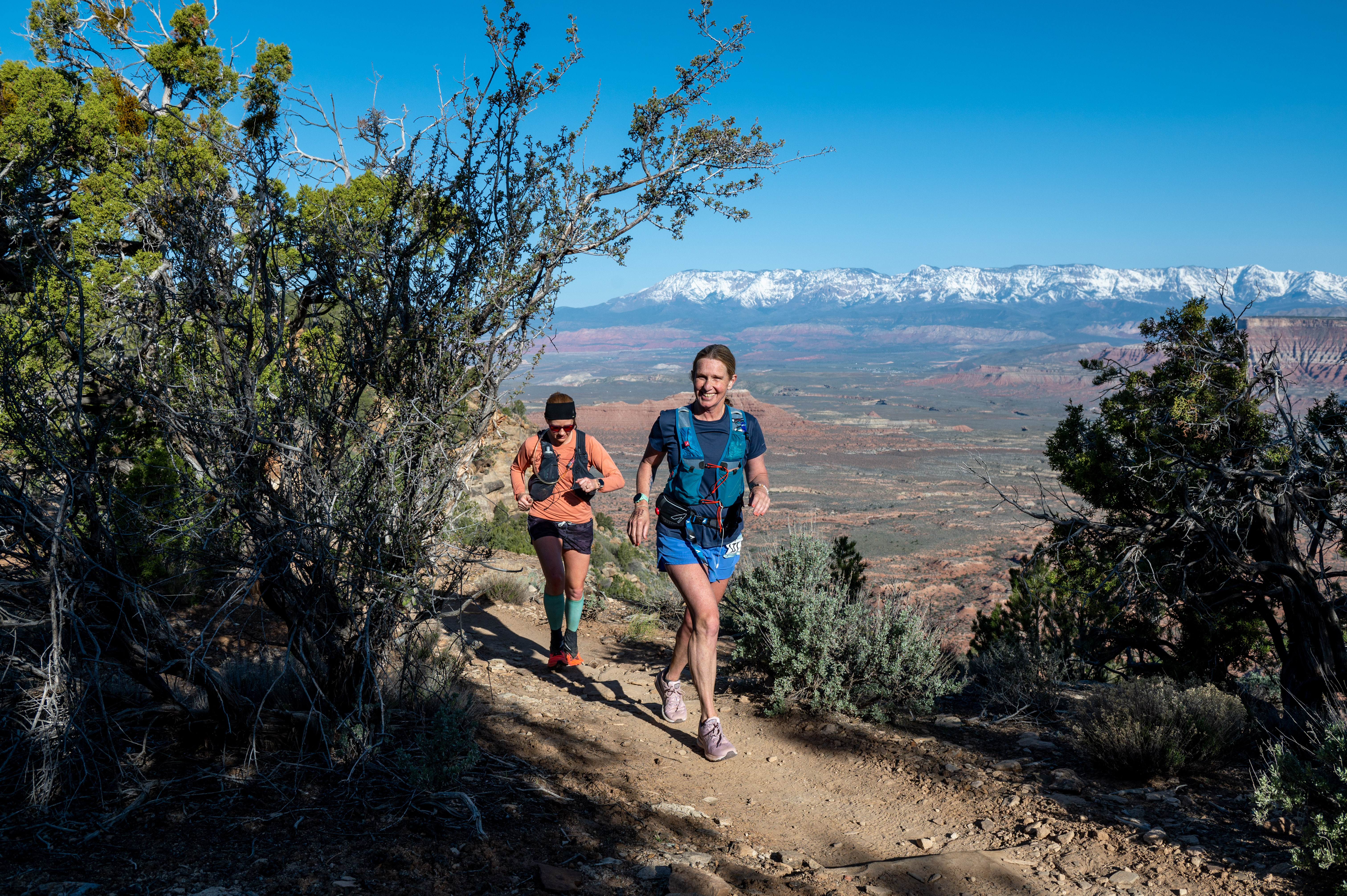
So, you sign up and complete your first 100-miler. Woohoo! You’ve inevitably followed some sort of training plan that has you hitting the trails day after day in all sorts of weather, moods and shifting states of fitness. Gradually the weeks ramp up in mileage, or “time on the feet,” until you realize that you’ve actually logged in close to 1,800 miles just to get to the the start of your first 100-mile race.
You remind yourself that it’s all about the process and not the outcome and that you’re just going to take what the day gives you and do your best. To that end, there are a plethora of articles, podcasts, social media sites, even a few ultrarunning books that offer an array of helpful training tips, nutrition advice, how many liters per hour you should be drinking, how many calories you should be ingesting, recommended salt intake down to the milligram, not to mention the deluge of information on what kind of shoes, socks, shorts, shirts, jackets, headlamps, waistbelts, hydration vests, trekking poles, GPS tracking devices, heart-rate monitors, watches, hand-held water bottles. There are lengthy reviews (if not full-on debates) as to which is the best anti-chafing cream that could very well save the day.
All of this information was extremely helpful. I pored over the various articles, listened to a myriad of ultrarunning podcasts, and flipped through my two ultrarunning tomes (Training Essentials for Ultrarunners by Jason Koop and Running Your First Ultra by Krissy Moehl) to gather more insight and ultra-knowledge.
To get some idea of the course, I zeroed in on every self-made documentary I could find that focused on the Zion 100 mile– the race I was about to embark on. I felt such gratitude for these folks (all 5 of them) for holding that selfie stick and running us through some of the terrain, making corny jokes, talking about some of their low points, providing us with a glimpse of the vastness and beauty and challenge we were in for.
There are so many platitudes about how it’s all worth it; the highs, the lows, the mental and physical hurdles you have to clear to reach that finish line and get that shiny belt buckle. (Side note: The belt buckle thing? I don’t really understand. Something to do with a horse race that became Western States Endurance Race (WSER), where people run instead of horses. But, back in the day, a man did run it when his horse went lame and maybe the only token offered to him for the herculean effort of running without any of the above-mentioned gear through the hot California canyons was some rancher’s old belt buckle? And now it’s a thing?)
Back to the finish-line feels. Hugs. Tears. Exhaustion. Stories. Most of all relief and an overwhelming sense of accomplishment and gratitude. If you’re a consumer of yummy alcoholic beverages (I am not) this is the perfect, almost iconic time to crack a cold one, take pictures with loved ones by the Finish Line or the celebratory gong or even some flicks by the wooden Zion Ultra Sign. Let’s do it!
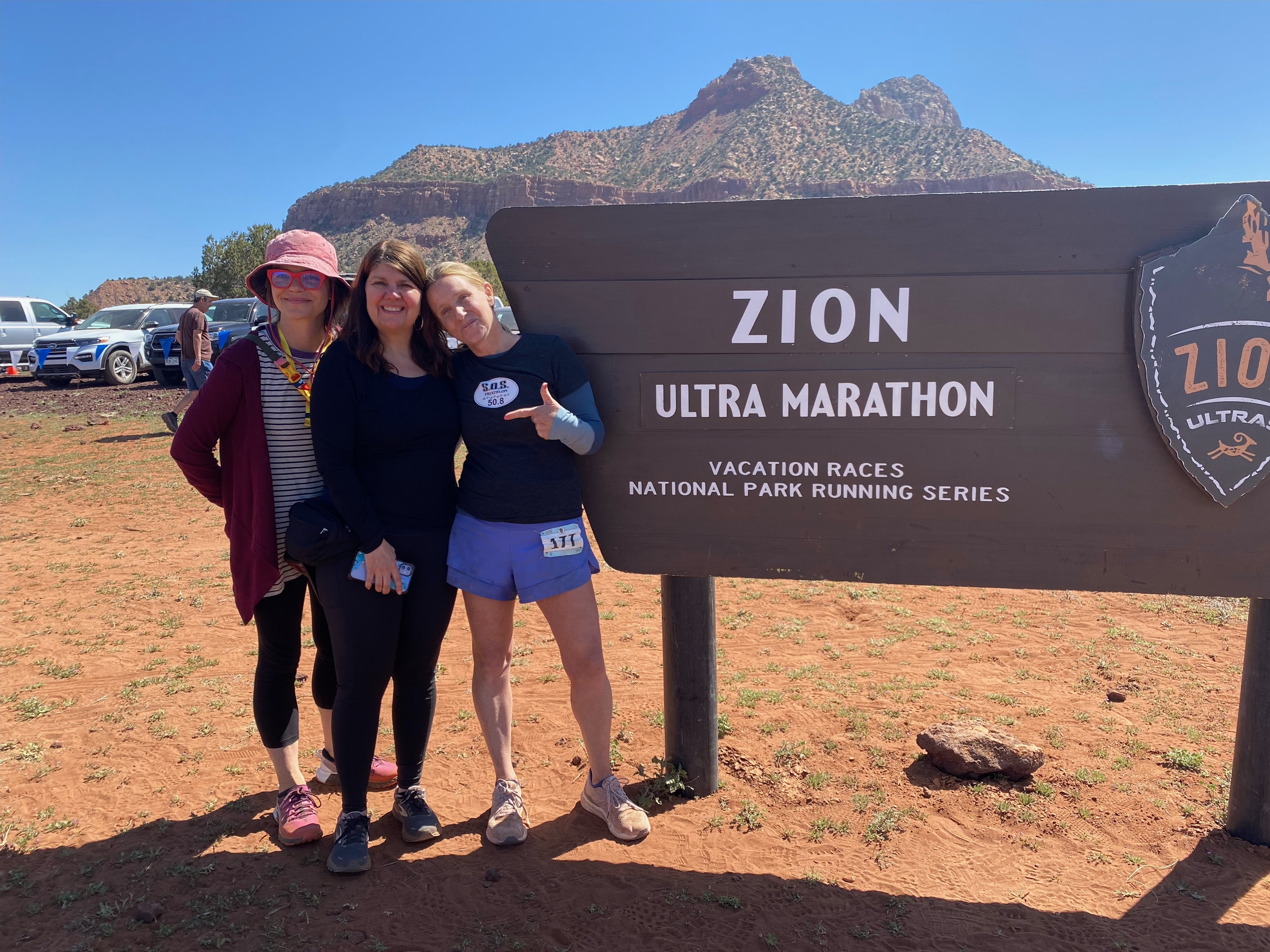
Despite finishing, having a great race, wanting to do and feel all of the things listed above (just replace cold beer with cold seltzer) I could NOT MOVE. I crawled into the medical tent, not because I needed medical attention but because it was the only place that offered shade in the desert sun which was heating up every minute getting close to a boiling point.
People talk about the “pain cave,” that you go into during an ultra, but as I was limped to the car, I realized that I hadn’t come across anything that talked about what happens after the ultramarathon. There’s no “What to Expect, when You’re Expecting” guide to this after party. One of the few things I found was an old article in The American Trail Runner Association (ATRA) Newsletter dating back to 2019. Runner Magazine where they interviewed the Pixie Ninja, Kaci Lickteig, a WSER Champion about her “recovery” post-race. They had 9 more people in this article, but I related the most with Kaci and found it comforting that I was experiencing some of the exact same things that she did, even though it took me 12 more hours to run the same distance. (I’m still confident that we could be friends.)
In an effort to be of service or comfort (hopefully not alarm) to my fellow ultrarunners out there, particularly the ones that are new to this party and were not sure what to expect at the After Party, I put together this list:
(Qualifier: I’m not a doctor or a nurse, nor do I play one on TV.)
10 Things No One Told Me to Expect after a 100-mile Run
- Nausea would not subside. Threw up on the drive back to the hotel. No victory dinner for me. No victory breakfast for me. The nausea lasted for close to 48 hours. Had to resume eating in small, little bites spread out over time. This was a special treat for my 100-miler as I did not experience this after my first 50K or 50-miler. After both of those ultra events, I ate like a champ.
- DOMS (Delayed onset of muscle soreness) While I’m thrilled that the soreness was “delayed” so that I could finish my run, damn did that pain come rolling through my muscles like a flash flood of “what the fuck?” I hurt so bad that after running a 102 miles (yes a hundred and two because I went off course at one point,) I could not make it from the shaded bench in the medical tent to the car, which was only a few hundred feet away. This got better over the next few days with the help of a massage gun as well as rolling out my legs with a foam roller when I was strong enough to actually prop myself up.
- Fluid Retention: I was so bloated and puffy and swollen that I was kind of scary. Like an Oompa Loompa. I had only peed about 3 times during the entire 29 hour run despite drinking water with electrolytes and lots of Coke the entire time. Steadily the water was released through urination over the next several days and I discovered my body again, kind of like after pregnancy but not as dramatic.
- Body Temperature Regulation: I felt like I had a fever for three straight days. I sat in the hotel lobby after the 100-miler with my two best friends who had generously and lovingly come out to Utah to crew me. I laid on the sofa and listened to them talk, trying to add in a comment or two but I felt so distant, like my mind was floating deep inside my bloated, fevered body. Turns out, this might be a “common” symptom, if there’s anything “common” about running a 100 miles. I never took my temperature, but I definitely experienced heat waves and chills back to back for the next several days. My internal thermometer was broken.
- Blisters: Yes. I knew I was likely going to get blisters. How could I not? Blisters are a single topic for an entire podcast episode, even multiple episodes. So I didn’t imagine I’d escape them. I felt “hot spots” while I was running and even had my crew check in on the state of my feet, but their true colors only began to reveal themselves the night after the run, the next day and subsequent days as they grew, like mushroom spores, one after another, spreading from my heels to the tips of my toes, taking out a few toenails as they emerged. My toes and feet felt like they were on fire for a few days. And then there were the underground blisters that rose to the surface, like pimples, days after the event had ended. Make sure to have lots of blister Band-Aids on hand for AFTER the race, as well as moleskin, alcohol wipes and nail-trimmers for what nails you have left.
- Swelling: My friend Joellen, who I paced for part of her 100-mile race, did warn me about the swelling. Still, as I sat on an airplane, heading from Utah to New York and my left ankle kept inflating like a helium balloon (not to mention the throbbing), I started to panic. Could this be a blood clot? Is it going to my brain? Was I so out of it that I broke my ankle and didn’t realize it? Both feet swelled, but the left ankle took an edema deep dive. It did get better. Propping my legs up against the wall helped, as did some cold water soaks in a mountain stream the next several days
- Fatigue: Okay. You’re thinking, “Duh? Who wouldn’t be tired after running a 100-miles?” I get it. But this isn’t running-tired. This bordered on narcoleptic-tired- when I’d be mid-conversation and then say, “Sorry, I have to take a nap,” closing my eyes and passing out before finishing my sentence- that type of fatigue.
- Hunger: After trying to force-feed yourself for 29 hours of intense physical activity that leaves you nauseous, drained, hurling trailside and out of a car window, hunger is something that you think you may never experience again. I certainly couldn’t bear to look at my Ziplock bags full of gels, chews, and protein-bars. But after about three days, I felt like I could eat a house. No food was safe. Even if the expiration date had passed. I was coming for it.
- Chafing: Another one that I thought I understood but didn’t realize could find new hiding spots on my body. I had chafing from my watch, my jog-bra, my hydration vest, my underwear, not to mention the chub-rub’s usual suspect locations. Lots of Vaseline. Baths were a double-edged sword. Epson salt soaks are great for DOMS, not so great for raw chafage. Pick your poison.
- Memory Loss: Wasn’t I just more present than I have ever been in my life? Watching every footfall to ensure I didn’t sprain an ankle or fall off of a canyon rim to my untimely death? Didn’t I look up and marvel at the desert in all of its glory at sunrise, sunset, and sunrise the following day? Didn’t I take in and thank each juniper tree and desert bloom and cacti cluster and mosaic of earth-born colors spreading out around me like a freshly painted canvas I was doing a full-body tuck and roll in? Then why couldn’t I remember which mesa I puked on? Where I made that friend from Oregon? What mile the Mondo Z climb from hell was on, or where that Lion King-like lookout point was? My memory had broken down like my soft tissues and muscles.
I was a numb nerve-ending and maybe I had just dreamt the entire thing? It was possible.


 Erin Quinn
Leave a reply to Erin Quinn Cancel reply