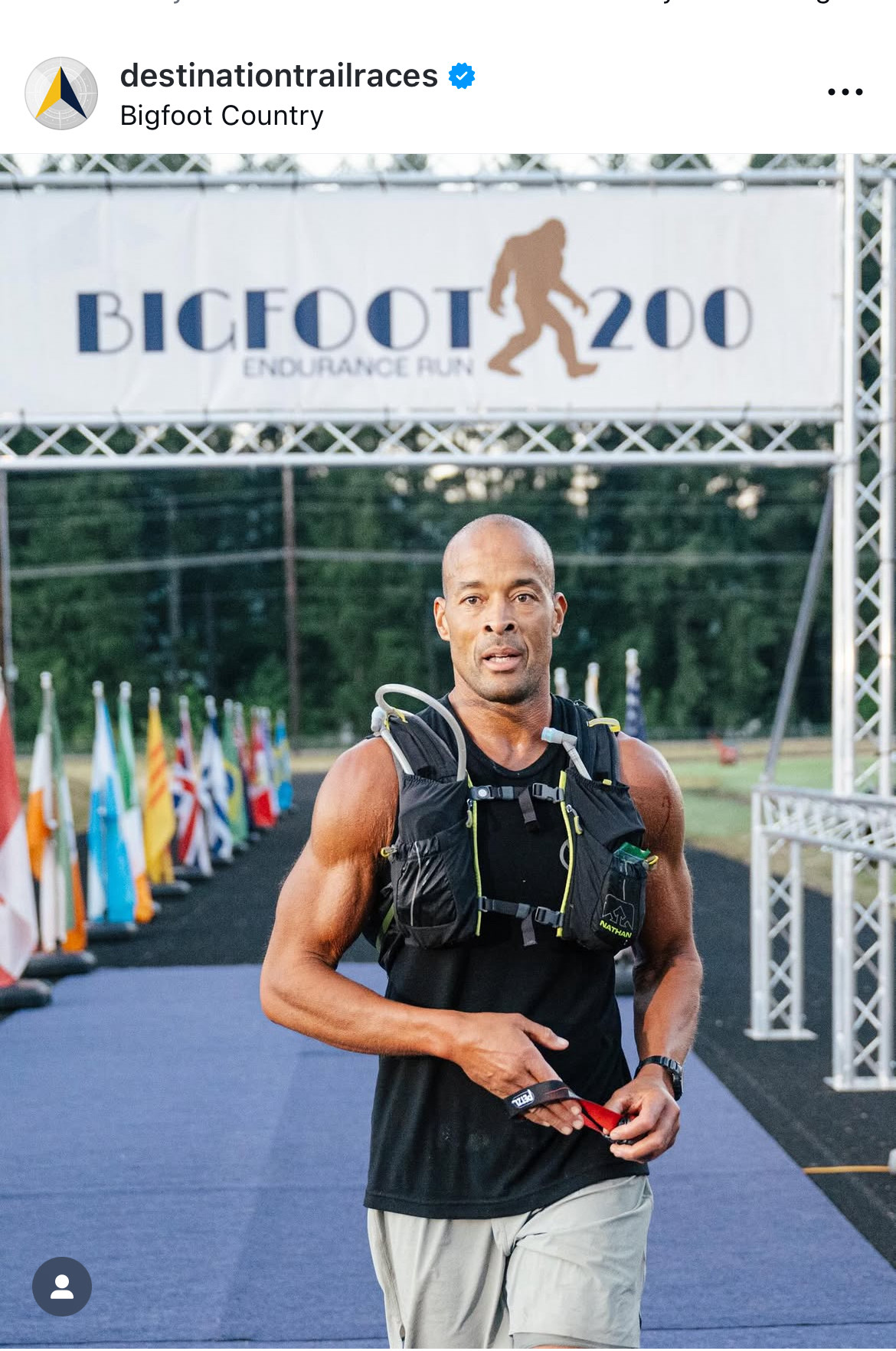
Running the Bigfoot 200 with David Goggins
I had noticed that David Goggins was on the Ultra Signup list for the Bigfoot 200—a wild and rugged 200-mile point-to-point race that traverses remote trails in the Cascade Mountain Range in Washington State. I would check the list from time to time to see how many women had signed up (62 total) and if I recognized any of their names. I was also signed up for Bigfoot and was hoping to see some friendly female faces as I would be doing the race without any pacers. Every time I looked at the signup list, some names would be added, some would have dropped, but Goggins remained.

I’m not a Goggins fanatic or devotee. But I am very aware of him, in a way that most athletes and specifically endurance athletes are aware of him. He has a presence in the endurance space that is almost omnipotent. A retired Navy Seal, a New York Times bestseller twice over with his debut memoir Can’t Hurt Me, and his follow up book, Never Finished. He’s also a motivational speaker, a Guiness Book of World Record Holder and an accomplished ultrarunner who reportedly completed his first 100-mile race on broken feet because he refused to give up.
You would have to work hard at not knowing who Goggins is, or at the very least, live in a world devoid of social media, podcasts bookstores and anything remotely having to do with the fitness culture. His YouTube videos and Instagram reels alone garner millions of views. They provide a steady diet of him running, usually in intense heat, shirtless, screaming at the camera for people to get up off their asses and get moving. There are also series of Goggins working out in his gym with NBA and MMA (mixed martial arts) stars. Despite their fitness and mastery of their particular craft, at some point, Goggins just outworks them. He lifts more, runs faster, climbs harder and they’re left gasping for air, or puking into a plastic garbage can. His mantra or battle cry to his audience right before he ends these clips is to “stay hard,” which in Goggins vernacular simply means, ‘stop your belly aching and do what needs to be done.’ Don’t quit. Don’t give up on yourself. Or to quote him directly, “When you think that you are done, you’re only 40% into what your body’s capable of doing. That’s just the limits that we put on ourselves.”
Goggins ethos is one of being able to pull yourself up by your bootstraps and change the course of your life by mastering self-discipline. He was an overweight, depressed, self-loathing youth from a poor neighborhood outside of Buffalo, NY who suffered from bullying, prejudice and the hands of an abusive father. He wanted to become a Navy Seal, but to even entertain that dream he had to lose weight, get in shape, learn how to swim, and overcome learning disabilities, crippling anxiety and most notably, to believe in himself against great odds.
He wasn’t born a great athlete or a great mind. But what Goggins had was the will to change his body and his mind through intense discipline and focus. It took him three times to complete Navy Seal training successfully. He lived, breathe, and dedicated every single second of his life towards achieving that one goal. It didn’t come fast and it didn’t come easy. He’s modern-day Horatio Alger story, but a Black Horatio who had to face obstacles like asthma, sickle cell anemia, a congenital heart defect and having to lose 106 pounds in less than 3 months to have a shot at passing the notoriously brutal SEAL training.
Becoming a Navy Seal wasn’t a one and done goal for Goggins, he then became the only military service member to have completed SEAL training, Army Ranger School, and Air Force Tactical Air Controller training. He served in the armed services for 20 years as a SEAL Chief and in the war in Iraq and Afghanistan. Add to this resume, a Guinness Book of World Record for completing the most consecutive pull-ups of anyone on the planet—4,030 to be exact in 17 hours with raw and bleeding hands.

I first learned of Goggins when listening to a Rich Roll podcast. Rich Roll had read about this Navy Seal who wanted to enter the Badwater 135-mile race through Death Valley, the hottest place on the planet. He needed a qualifier and so he entered a 100-mile race and continued to run even when the bones in his feet had broken. Roll, also an endurance athlete, wondered, who in the heck is this guy? This was before the trail running implosion and ultramarathons were at best a fringe sport for extreme athletes. Roll read a tiny article about Goggins and was compelled to find out who he was and more importantly, what was his story?
Roll first interviewed Goggins in 2017, before he became Goggins—a name that is weighted, like Prince or Madonna, only Goggins isn’t singing. He’s lifting, running, cycling, swimming and pushing himself to the point of failure for hours a day, every day, no days off. This was before the best-selling books, the speaking tour and certainly before the mere mention of Goggins name elicited a reaction—awe, fear, admiration, anger, but mostly, inspiration.
I loved this interview because it was all new to me. Who Goggins was, where he had come from, what obstacles he had overcome and his belief that the only limits we place on ourselves come from our mind. That we’re all capable of much more than we know. There was a vulnerability and a rawness to this interview that I found compelling. His physical prowess was otherworldly, but underneath that was just a man, who did not want to go back to that feeling of being a helpless, hopeless boy. He wanted to stay the narrator of his own life, the director of his own film, the star of his own movie, the superhero that swept in to save himself, and anyone else who had once felt as powerless and defeated as he had felt.
When you’ve become as big as Goggins has become, amassing millions of followers on social media platforms, selling hundreds of thousands of books, becoming one of the most sought-after motivational speakers and all the while having a world-class physique? You’re going to have critics. Lots of critics. His yelling and cursing and “stay hard,” mantra is not one that embodies empathy or understanding or gentle encouragement. It’s an order. From Goggins. Do this and become better or don’t do this and suffer the consequences. Your life, your choice, but you do have a choice. Just look at me mother f*&ker!
I am not one of those critics. I have great appreciation for Goggins story, am in awe of what he’s been able to achieve in the endurance space and believe that he’s helped motivate an untold number of individuals to either begin or fortify their exercise journey and to believe that they have the power to change the trajectory of their lives. Screaming, cursing and chest-pounding is certainly not my style. Not at all. But it doesn’t have to be. It’s Goggins’ style and his followers devour it like protein supplements.
I was excited that Goggins would be at the Bigfoot 200. Having someone of his stature only helps elevate a sport I love. As far as 200+ mile races go, Bigfoot is notoriously remote, rugged, requiring more than 44,000ft of climbing up Range with an equal amount of descent on primitive trails. I’m not sure if there is a “sexy” 200+mile race, but Bigfoot is certainly one that falls under the radar in a sport that barely has a radar. There are few cameras, almost no media, and even less fanfare. It’s just the runners, the organizers, and the volunteers for days on end trying to get this moving amoeba of 260 people from point A to point B with as few causalities as possible.

It begins in the Mt. St. Helen’s blast zone area where runners have to traverse boulder fields, utilize ropes to scale up steep embankments and ascend exposed switchbacks of volcanic ash, just to get into the heart of the race.
Having heard that Goggins hadn’t competed in an ultra in more than 4 years and had undergone knee surgery, I was impressed that he had chosen this particular race for his reentry into the world of ultras. By definition, ultramarathons (any length of race that is greater than the traditional 26.2 marathon distance) are hard. To run that long and far requires a certain amount of physical and mental toughness. You can’t just “wing” a 100-mile or a 200-mile race.
I had heard him tell the story of running the Moab 240, which like Bigfoot 200, is put on by Destination Trails. That race starts in the desert and red rocks of southern Utah but then takes runners up into two mountain ranges—the Abajos and the La Sals, at altitude, before returning them back to the slick rock and desert landscape. According to this particular tail from the Goggins trail, at a certain point in the race, he became so ill that he had to drop out and get to a hospital. After being treated and receiving IV fluids, he began to feel better and immediately started thinking about finishing the rest of the 240-miles that he had yet to run. While he was officially out of the race, there was nothing stopping him from finishing it on his own. So, he was dropped off at the point where he had DNFd (did not finish) and ran the rest of the course all the way to the finish line which had already been dismantled. There were no fans, no spectators, just a man who wanted to prove to himself that he could finish what he had started.
The story was very Gogginsesque.
From what I had seen, it appeared that Goggins did well in the heat, in the desert, on more even, runnable terrain. Bigfoot had none of those elements. This course was wild, burly, mountainous and had almost no flat sections. You were either climbing up or barreling down and in between trying to navigate gnarly trails through old growth forests, deep into the Pacific Northwest, where the tunnels of green were so thick and the blowdowns so extensive that people who had run the race before jokingly counseled people to bring a “chainsaw” or a “machete,” to maneuver their way through.
What I found compelling about Goggins, wasn’t as much his physical prowess, as much as his mental game. From some of the people that had interviewed and/or trained with Goggins, like Roll, bow-hunter and endurance athlete, Cameron Hanes, and Andrew Huberman (a neuroscientist and podcaster) was his ability to lean into the things that scared him. He didn’t appear to curate challenges that fit his strengths so that he could post them online. What Haines, Roll and Huberman found so fascinating about Goggins was the way he instantly moved towards things that would expose his weaknesses, challenges that held great risk of failure. Huberman had recently interviewed Goggins about his quest to become a paramedic in Canada. Here was a multi-millionaire who was spending hours a day studying, noting that his dyslexia required him to read the same page of notes over and over again, in an effort to have the skills to be able to save another person’s life.
In a way, Bigfoot 200 would be a perfect reentry for Goggins. It would put his knees, his body, his mind to the test. This was not the artificial and controlled landscape of his home gym or the roads around Vegas. This was deep into the heart of the Pacific Northwest with few cameras, almost no media and even less fanfare in sight.
Ironically, we arrived at almost the same time Goggins did to the pre-race check in. We were coming from upstate New York and after logging in an all-nighter as flights were delayed and then cancelled, we had hopped onto the last flight that would allow me to get to the race check-in on time. The check-in and the race-finish were both located at a small high school track in Randle, Washington. By the time we got our rental car, drove the hour and a half from the airport to Randle we had less than 20 minutes to spare before check-in closed.
I got my index card where all the various check-in stations would have to sign-off on before I could pick up my race bib and bag. As I look around, who did I see on the same line to get our gear checked, but Goggins himself. All 6’2” of him. He was no less impressive in person than he was on camera. He was taller than I had thought, absolutely jacked, with a smooth bald head, broad shoulders and an intensity that seemed to permeate the air around him. My son Seamus and I just stared. He was built like a Marvel superhero, but without a cape. He was dressed in sneakers and a sweatshirt with a hood that he kept pulling over his head in an effort, I assumed, not to be recognized.

I wished I was cooler than I was and unphased by his presence, but I could not take my eyes off of him. It’s strange to see someone that is larger-than-life, be placed into the real world, with their back pack open, having some long-haired volunteers rifling through their sack to make sure they had everything the race required.
I had already thought about what I would say to him, if I had the opportunity meet him at this race. It had to do with sneakers. And as I watched him move from the gear check to the GPS device station, I noticed that he was wearing, what appeared to be a brand new, or at least unsullied pair of Asics Gel running shoes.
This was our big common denominator. In the huge constellation of the universe this was where David Goggins and I crossed paths. It was the shoes. A year earlier, I was deep into my first 200+ mile race, The Moab 240. It was the middle of the night. I was at an aid-station with painful blisters on my feet. I asked if the medic could take a look at them. When I took of my shoes to present my mangled feet to him, he exclaimed, for all to hear, “you’re running the Moab 240 in Asics road shoes?” That caused another medic and a few of the runners at the aid station to gather around me as if I was an ultrarunning sideshow. There were lots of gasps and expressions of shock and even a bit of horror, but all I could respond with was the truth. “I’m just used to these shoes and they say not to try anything new on race day.”
The second medic that was eyeing my shoes said that the only person he could ever recall running the Moab 240 in Asics was David Goggins. “He finished the entire thing in a pair of Asics road shoes.”
“I guess I’m in good company then,” I offered. He patched up my blisters and I slipped my Asics Gel Nimbus back on and off I went, running with the confidence that if Goggins could tackle the Moab 240 in road shoes than so could I.
I was thinking about this as I watched him, flagged by his fiancé, Jennifer Kish and another formidably fit, bald man who looked like he might be a manager or a pacer or simply a friend? What was amazing was that someone of his notoriety and stature had to go through the motions on this high school track in rural Washington just like the rest of us ultrarunners. His bag was checked. He had to talk to medical personnel, he had to show that he had the course map downloaded on a GPS device and that he could use it. He had to get his pre-race photo and then pick up his bib and duffle bag (with a t-shirt, mug, wag-bag and emergency bivvy) the same as anyone. I saw people ask to get a picture with him or slip him a note or to simply shake his hand and wish him good luck.
As I watched him maneuver through the check-points, I saw his hoodie go on and off and back on and back off. It was a thin disguise, but maybe it made him feel a bit more protected. I saw his crew band together with Ashley Paulson and her crew. Paulson is a professional triathlete, ultrarunner and @ifit coach. She’s a badass with pink hair and a mother of 4. She’s also won the Badwater 135. All of those things, plus the fact that she’s always smiling whenever I’ve seen her, make me both like her and be slightly in awe of her. As they all stood together, Paulson’s husband with Goggins’ crew I thought to myself that there wasn’t one ounce of bodyfat or untoned muscle between the entire lot of them. Seamus and I talked about asking Goggins for a picture. It was hard to pass up the opportunity but almost equally as hard to approach him. I thought it was cool was it that we were both about to toe the line for the same race. That’s something that only happens in ultrarunning–amateurs competing alongside elites.

Goggins’ reach is far, and his fanbase plentiful, the Bigfoot 200 squad, at least from what I could see, was not violating his space at all, save for an occasional request for a photo or a heartfelt handshake. At one point, I was able to slide right in next to Goggins who was leaning against the railing of the track. all my himself, listening to the mandatory pre-race meeting being delivered by Candice Burt, the owner and creator of Destination Trails. He had his hood up, he was staring straight ahead, his eyes so narrowed and fierce that it looked like he was about to jump into the ring with the devil himself. This was no show. There was really no one around except a bleacher half-full of ultrarunners and their crew. We were not at a Vegas venue where Goggins was on stage on his his gym with a camera crew and a visiting celebrity athlete. Here, he was just a another participant, going through the motions that the rest of us had to go through. Yet he remained as true to form as any reel or clip I’d ever seen of him.
When it came to the wag-bag talk and demo (how to poop in a bag and line it with powder to carry out of the woods in an effort to ‘leave-no-trace’ ) I found my moment. I turned to Goggins and said, “Are you going to wear those shoes tomorrow?” glancing at his Asics “No,” he responded and then added, almost defensively, “But they’re good shoes!”
“Yes they are,” I said, pointing to my own pair of newly minted Asics Gel Nimbus that I had saved for this race. He looked at me curiously, but I continued. “I learned that you and I have one thing in common,” I said. “We might be the only people to have ever completed the Moab 240 in Asics road shoes.” With that he gave a laugh. Or a half-laugh. A chuckle of some kind. If I had made Goggins laugh, or even smile, I had done something extraordinary because that man’s resting face was hardly jovial.
I backed away from the track towards the end of the talk as the sun had begun to beat down on me. I found Seamus standing off behind us. He had snapped a few pictures of Goggins and I from behind and sent them to our family group chat. “You ready to go?” I asked. He said that he was and just as we began to walk away the meeting had formally ended. Without warning and to my surprise, Seamus caught Goggins attention and told him we were big fans of his and would love to get a picture with him.
“Okay. Let’s make this quick,” he said, looking behind him and realizing that there would be more fans to follow.
His manager/pacer/fit-friend took the pic and we thanked Goggins and he just looked at us both in the eyes and said, very intensely, “I appreciate you.” I told him good luck on the race and that was that. He bolted quickly towards the parking lot and then beyond the parking lot into a tunnel that must have led to a trail. He was gone as quickly as he had arrived like an apparition. Had I just met him and talked to him? Our family group chat exploded with reaction to the pics.

I thought about my mental state and how nervous I was and how, despite all of my training and preparation that there really was no way of preparing oneself for this type of feat. It was going to be an adventure. It was going to be hard. It was going to be painful. It was certainly going to be beautiful and terrifying and risky and rewarding and some combination of all of those things. That I knew. I also knew on a deep level that regardless of how locked in I was, that there was no guarantee of success. Just arriving at the finish line before the cut off (a 107 hours) would require everything I had and that might not be enough. In a 200+ mile race there are so many ways for things to go South. One mistake, one misstep, one blunder and the entire house of cards could come crumbling down. I thought about this and I thought about Goggins. If I didn’t make it? I would be sad and disappointed and certainly crestfallen. For a time. But it would be a personal failure and not one that I would have to share publicly beyond my small inner-circle of family and friends. If Goggins failed? If his knees gave in, or if he twisted an ankle, took a fall, experienced heat exhaustion or hypothermia or got lost? All things that can easily happen on these runs? His failure would be magnified by exponential proportions and undoubtedly ignite his critics into a feverish state.
We’re all taking risks here. We were all putting ourselves in a very vulnerable position. For Goggins, it was both a personal risk and a professional one and I admired him for choosing to put it all on the line. It was those decisions, that made him so authentic. He wasn’t chasing a belt buckle or t-shirt or a podium. He was chasing himself. That’s quite a large shadow to chase but for Goggins, there is no finish line, there is no promised land. There is just the work. Critics can say whatever they’d like, but they’re not out there, in the middle of the woods, willingly lining up to run 200 miles in unpredictable weather and unforgiving terrain.
The next morning, I could see his crew out and about in a tiny parking lot in the National Forest by Cougar, WA. Goggins was still inside of his vehicle and stayed there until the Candice Burt, megaphone in hand, called him to pick up his tracker and get to the start-line, which he did. I imagined that he was trying to get in his zone without the interruption of fans, even long-haired, tattooed, grizzled, mountain running fans.
And here’s what makes ultrarunning so special. Despite our age, gender, race, station in life, and whether we’re front of the pack, back of the pack or somewhere in the middle, we’re all going to run the same course on the same day, and in this case, days, in an attempt to get to the same finish line. It might just take us all a different amount of time to do it.
Goggins got to the finish line and in Goggins fashion made a reel at mile 199, just a mile from the finish line where he called people out for doubting him, talked about his hiatus from social media and asked what in the hell everyone else had been doing for the last 64 hours because he had been “getting it in,” and running “all up and down the mountains. Stay Hard!”
My son Seamus, who crewed me, jumped in to pace me, volunteered at various aid-stations, had seen Goggins throughout the race and told me that he had finished and posted a reel that would make me laugh. “It was so Goggins!” he said. “You knew he was going to do it. It’s already gone viral in the past few hours.”
While Goggins got to that finish line 20 hours before I did, we both started and ended up in the same place. He came in 23d and I came in 81st. He finished in 66 hours and I finished in 86 hours. But you know what? I was able to put myself to the same test as one of the fittest human beings on the planet. I was able to experience something that only Goggins, Paulson (who came in 1st place for females and 5th overall and set a new course record) and another 206 individuals got to experience—running up and down the Cascade Mountains, all day and all night for more than 3 straight days His reel drew so much attention and millions of views. While I found it entertaining, it was his post that followed, a day later, that really touched me.
The second Bigfoot 200 post he put out showed him at the finish line, looking beat up but triumphant. He explained that this was his first ultra in 5 years. He then went on to say:

I want to congratulate all of the finishers of the Bigfoot 200. It’s truly an epic race that will break you the fuck off if you aren’t ready for it. More importantly, I want to congratulate those who signed up but didn’t finish the race. Having the courage to sign up for a race like this sets you apart from so many people in this world. You may not have made it to the finish line, but along your journey at Bigfoot, you found out so much about yourself. You reached beyond your limits to get as far as you could and now you will know the next time you show up to a race like that, you now have the knowledge to finish it. These races aren’t about winning or losing or even finishing. It’s exploring oneself and the human potential that lies within all of us. No matter what place you came in or if you DNF’d, you came out a better person.
Stay hard!
I couldn’t agree more. Goggins has every reason to stay soft. He has money, fame, a slew of career and athletic achievements. It would be so easy to choose a race that catered to his strengths, was gentler on his knees, offered a higher probability of success. But here’ the thing about Goggins. He is who he says he is. He didn’t run Bigfoot to prove anything to anyone except for himself. And that’s what impressed me the most. Despite his notoriety, his action figure-like physique, and his almost mythological presence in the world of athleticism, Goggins, for three straight days, was doing what all of us were doing, putting one foot in front of the other, for 200 miles, trying to make it back to that high school track, in the middle of Washington State, where, if you were lucky, there might be a few people awake with cowbells in hand to help ring you in.
Congratulations to David Goggins and to all of the runners out there. It was an honor to be able to share some miles and trails in the belly of the Cascades under a full-moon which helped to light our way. Until next time.

—-Erin Quinn


Leave a Reply